A $93.85 EVgo-powered charging receipt shows why EV road trips need price filters
The charger apparently worked. The surprise was the bill.
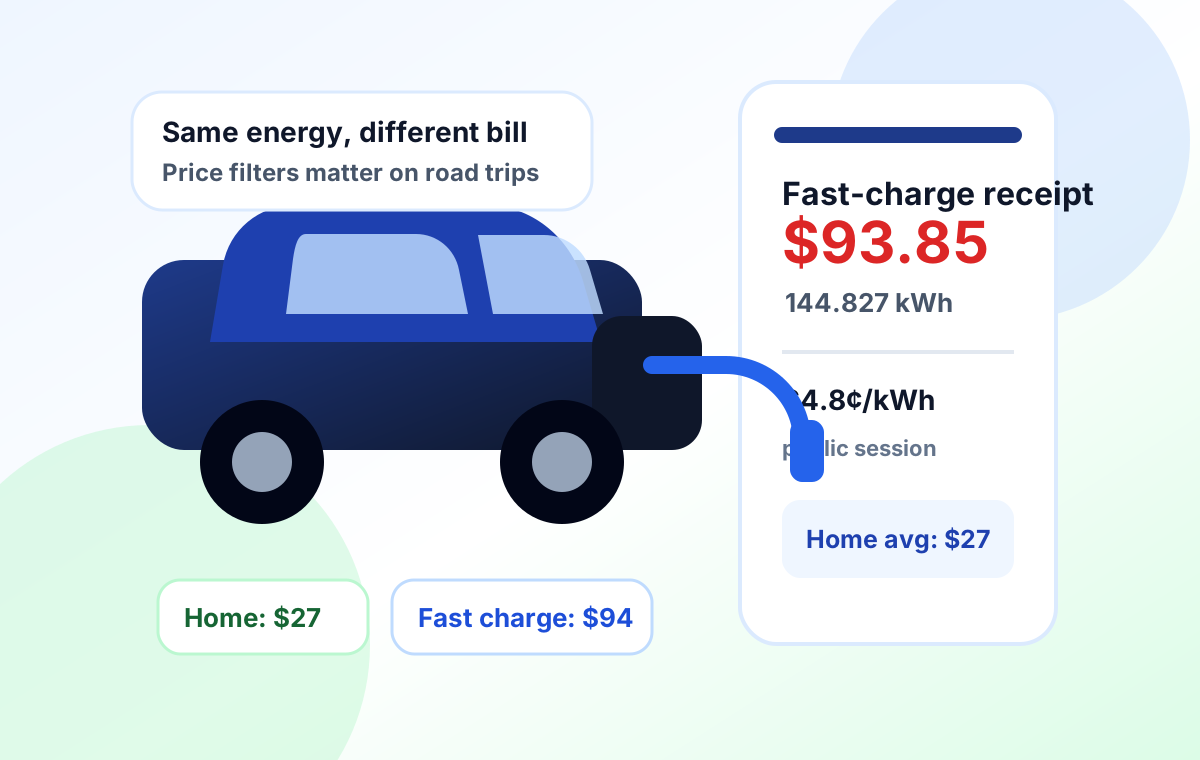
A GMC Sierra EV road-trip receipt is a good example of the new anxiety for electric pickup drivers.
Not range anxiety. Receipt anxiety.
EVShift, mirroring a Torque News story, reported that GMC Sierra EV AT4 owner Gary Brown drove from Florida to Muskegon, Michigan, roughly 1,300 miles, and shared a charging-account screenshot showing six Pilot and Flying J charging sessions powered by EVgo eXtend.
The visible session amounts were:
Those six visible charges total $453.64. The most attention-grabbing receipt showed 144.827 kWh delivered and $93.85 paid. That works out to about 64.8 cents per kWh.
That does not prove that EVs are always expensive. It proves something narrower and more useful: a large electric truck can turn a premium public fast-charging rate into a very large receipt.
The same energy, six different bills
Using the 144.827 kWh visible on the $93.85 receipt, here is what the same energy would cost under several pricing assumptions.
| Charging scenario | Rate | Cost for 144.827 kWh | Caveat |
|---|---|---|---|
| Actual Pilot/Flying J / EVgo-powered receipt | 64.8¢/kWh | $93.85 | Receipt-derived |
| Tesla Supercharger sensitivity — low | 35¢/kWh | $50.69 | Model only; station prices vary |
| Tesla Supercharger sensitivity — mid | 45¢/kWh | $65.17 | Model only; station prices vary |
| Tesla Supercharger sensitivity — high | 55¢/kWh | $79.65 | Model only; station prices vary |
| U.S. average residential electricity | 18.83¢/kWh | $27.27 | EIA April 2026 average |
| Illustrative off-peak home charging | 10¢/kWh | $14.48 | Utility-specific example |
The home-charging comparison is the cleanest one. The U.S. Energy Information Administration listed the U.S. average residential electricity price at 18.83 cents per kWh for April 2026. At that average, 144.827 kWh costs about $27.27.
The Tesla comparison needs more care. A Supercharger stop might be cheaper, similar, or occasionally not much cheaper depending on the station, time, payment terms, membership, and non-Tesla access rules. That is why the table uses sensitivity cases instead of claiming one universal Tesla price.
The EVgo / Pilot pricing detail drivers should notice
These were not ordinary “every EVgo plan applies everywhere” stops. EVgo's Pilot Flying J page says the stations are part of the EVgo eXtend network and that EVgo pricing, plans, and charging programs may not apply. EVgo also says Pilot Company sets prices at each station and pricing varies by state.
That is the important driver lesson. Seeing EVgo branding, GM Energy branding, a Pilot or Flying J travel center, and a 350 kW charger does not guarantee a specific price. The actual bill can depend on the site and the way the session starts.
What the visible trip math says
If the six visible receipts are compared with the reported 1,300-mile trip, the visible cost works out to about 34.9 cents per mile. If the truck averaged 1.8 miles per kWh, as the EVShift story says Brown mentioned in comments, the trip would require roughly 722 kWh of battery energy. The visible $453.64 total then implies about 62.8 cents per kWh.
Those are useful back-of-the-envelope numbers, not a final audit. The screenshots do not prove the starting battery level, ending battery level, all charging sessions, route, speed, weather, payload, exact membership status, or whether any fees were included.
Safe takeaway
This receipt does not prove that a GMC Sierra EV always costs as much as gas. It does not prove that Tesla would have saved exactly $500. It does not prove that EVgo is always more expensive than Tesla.
It does show that EV road-trip planning needs a price layer. Drivers should compare the price of nearby chargers before arrival, not just the connector and speed. A large battery is not only extra range. It is also the ability to skip an expensive stop if a cheaper reliable one is within reach.
What to do before your next electric-truck road trip
- Check price before you plug in. Plug type and charger speed are not enough.
- Compare nearby operators. EVgo, Tesla Superchargers, ChargePoint, Electrify America, IONNA, and site-host pricing can differ on the same corridor.
- Use range to shop. A big pack can help you skip a premium stop if a cheaper reliable charger is reachable.
- Separate charger price from vehicle efficiency. A Tesla may cost less because the charger is cheaper, because the vehicle uses fewer kWh, or both.
Planning a road trip?
Use the charging directory to compare nearby stations before you stop. The cheapest mile may be the charger you skip.
Find EV charging stations near your routeSources
- EVShift / Torque News — “A 2026 GMC Sierra EV AT4 Owner Hit $93.85 at One EVgo Stop…”
- EVgo — Pilot Flying J Charging Network powered by EVgo eXtend
- EVgo — EV charging costs, pricing, and plans
- U.S. Energy Information Administration — Electric Power Monthly Table 5.6.A
- Con Edison — Time-of-Use rate page, used only as an example of off-peak pricing caveats